
How to Choose and Use a Mobility Scooter in Singapore: A 2026 Caregiver’s Guide

Could the wrong choice of equipment today leave your loved one stranded when the new 2026 regulations take full effect? As a caregiver, you want to provide independence, but the introduction of the Certificate of Medical Need (CMN) has created significant uncertainty. You might worry about buying a mobility scooter Singapore authorities could eventually ban, or perhaps you're anxious about battery safety and HDB lift access. It's a lot to manage while you're focusing on daily care.
We're here to help you understand these requirements with confidence. This guide explains how to secure the necessary medical certifications and select a scooter that meets every safety standard. You'll learn about maintaining long-term reliability and ensuring your equipment fits seamlessly into your home environment. By the end, you'll have a clear roadmap for choosing a compliant, dependable mobility solution that prioritizes both safety and freedom.
Table of Contents
How to Comply with Singapore’s 2026 Mobility Scooter Regulations
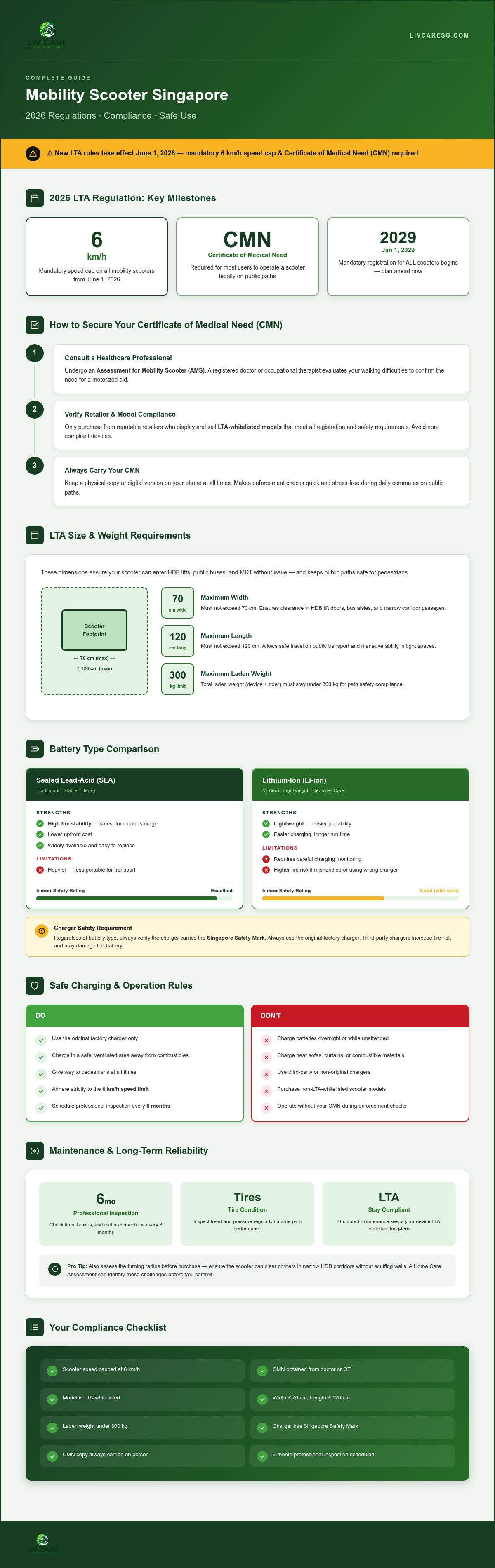
The Land Transport Authority (LTA) is introducing new measures to keep public paths safe for everyone. Starting June 1, 2026, every mobility scooter Singapore residents use must have its speed capped at 6km/h. This transition is designed to create a safer environment for both riders and pedestrians by aligning device speeds with a brisk walking pace. You'll need to check if you or your loved one requires a Certificate of Medical Need (CMN). While seniors above a certain age may have different criteria, most users will need this medical proof to operate their device legally. It's also helpful to remember that mandatory registration for all scooters doesn't start until January 1, 2029. Taking these steps now ensures you aren't caught off guard by enforcement changes.
Securing Your Certificate of Medical Need (CMN)
The process for obtaining a CMN is straightforward but requires professional input to ensure your mobility scooter Singapore usage remains legal. Following these steps helps maintain your independence without legal interruptions.
Consult a Healthcare Professional: You must undergo an Assessment for Mobility Scooter (AMS). A registered doctor or occupational therapist will evaluate your walking difficulties to confirm the need for a motorized aid.
Verify Retailer Compliance: Only buy from reputable sources. Ensure your retailer only displays and sells registered models that meet LTA's whitelisting requirements. We offer a curated range of mobility scooters that already meet these strict safety standards.
Carry Your Certification: Always keep a copy of your CMN with you, whether it's a physical paper or a digital version on your phone. This makes enforcement checks quick and stress-free during your daily commutes.
How to Choose the Right Mobility Scooter for Singaporean Living
Finding a mobility scooter Singapore users can take on the MRT or into HDB lifts requires checking specific dimensions. LTA mandates that these devices don't exceed 70cm in width and 120cm in length. These measurements aren't just for compliance; they're practical limits that prevent you from getting stuck in tight doorways or being turned away from public buses. Selecting a model that fits within these bounds ensures your loved one can move through the city without restriction.
Battery choice is another major factor when selecting a mobility scooter Singapore families will store indoors. Sealed Lead-Acid (SLA) batteries are known for their fire stability, making them a reassuring choice for indoor storage. While Lithium-ion batteries are popular for their lightweight feel, they require more careful monitoring and specific charging habits. Regardless of your choice, verify that the charger has the Singapore Safety Mark to protect your home from electrical hazards.
Matching Scooter Features to the Home Environment
Navigating a flat involves more than just speed. You need to assess the turning radius to ensure the device can clear corners in narrow corridors without scuffing walls. A Home Care Assessment is a practical way to identify these hurdles before you commit. We also look at weight limits, as the total laden weight must stay under 300kg for path safety. If you're feeling overwhelmed by the technical specs, our team at Liv.Care Singapore is here to guide you through our curated selection of mobility aids.
How to Safely Maintain and Operate Your Mobility Scooter
Owning a mobility scooter Singapore seniors can depend on involves more than just understanding the road rules. It requires a commitment to proactive maintenance and safe handling at home. Charging practices are the most critical safety factor for your family's peace of mind. You shouldn't charge batteries overnight or leave them unattended near combustible materials like sofas or curtains. Always use the original factory charger that came with your device. Using third-party chargers can damage the battery and significantly increase fire risks.
When you're out on public paths with your mobility scooter Singapore, remember that safety is a shared responsibility. You must always give way to pedestrians and strictly adhere to the 6km/h speed limit. This pace ensures you can react quickly to unexpected obstacles. To keep your device in peak condition, we recommend a professional inspection every six months. Checking your tires, brakes, and motor connections twice a year prevents mid-journey breakdowns and extends the life of your equipment.
Ensuring Long-Term Reliability with Care Coordination
Consistency is key to sustainable independence. You can leverage our Care Membership to access ongoing maintenance support and exclusive benefits designed for mobility aid upkeep. This structured support takes the guesswork out of technical care and ensures your device remains LTA-compliant. Before the first outdoor trip, take time to educate the user on the delta tiller operation and emergency braking. Building this confidence in a quiet environment makes real-world navigation much safer. For more tips on maintaining freedom, you can reference our guide on mobility scooter safety for seniors. We're here to ensure your journey is as smooth and secure as possible.
Empowering Senior Independence with Confidence
Securing the right mobility scooter Singapore seniors need involves balancing regulatory compliance with everyday practicality. By understanding the 2026 LTA requirements early and selecting a device that fits both your home and public transport, you're investing in long-term freedom. Proper maintenance and safe charging habits further ensure that this independence remains sustainable and secure for years to come. We're here to support you through every step of this transition with expert care coordination and our specialized membership benefits.
If you're ready to see how a compliant device fits into your lifestyle, visit our showroom for a test ride. We've ensured our entire collection meets the upcoming standards, giving you one less thing to worry about. Explore our curated range of LTA-compliant mobility scooters today to find the perfect match for your family. Your journey toward safer, more reliable mobility starts with a single, well-informed choice.
Frequently Asked Questions
Can I use my mobility scooter on Singapore roads?
No, you cannot use your mobility scooter Singapore on public roads or expressways. These devices are classified as Personal Mobility Aids (PMAs) and are strictly meant for footpaths and cycling paths. Using them on roads is illegal and poses significant safety risks to you and other motorists.
Do I need a license to drive a mobility scooter in Singapore?
You don't need a driving license to operate a mobility scooter. While no formal testing or license is required, the 2026 regulations mandate that users obtain a Certificate of Medical Need (CMN). This document verifies that you have a genuine walking difficulty and require the aid for daily mobility.
What happens if my mobility scooter exceeds the LTA dimension limits?
Scooters that exceed the 70cm width or 120cm length limits are prohibited from boarding buses and MRT trains. Additionally, LTA enforcement officers may stop you on public paths if your device is oversized. It's best to choose a model that adheres to these dimensions to ensure uninterrupted access across the island.
Is the 6km/h speed limit mandatory for manual wheelchairs with power attachments?
Yes, the 6km/h speed limit is mandatory for manual wheelchairs with power attachments. LTA treats these as motorised PMAs. This rule ensures that all powered mobility aids travel at a pace consistent with pedestrians, which reduces the likelihood of accidents on shared public paths.
How do I know if my mobility scooter is LTA-compliant?
You can verify compliance by checking that the device's maximum motor-assisted speed is capped at 6km/h. Ensure the physical dimensions don't exceed 70cm by 120cm. Reputable retailers only provide a mobility scooter Singapore residents can legally use, ensuring every model meets current and upcoming LTA standards.
Can I bring my mobility scooter on the MRT and buses?
You can bring your scooter on the MRT and buses if it meets LTA's size and weight requirements. The device must be within 120cm in length and 70cm in width. Most public transport infrastructure in Singapore is designed to be inclusive, provided your equipment falls within these specific safety parameters.



Comments